Tag Archive: activity days

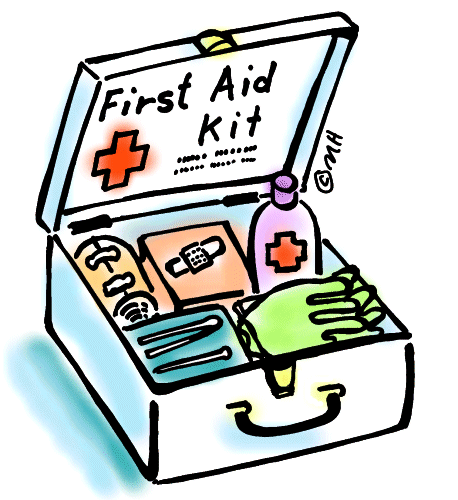
Baby Sitting First Aid Basics -(simple)

As members of The Church of Jesus Christ of Latter-day Saints, we recognize that both our temporal well-being and our spiritual well-being are important.  By learning how to avoid accidents and how to take care of some common accidents, we become better prepared to protect and take good care of our temporal bodies.  It is also important that we have some basic first aid skills.  When we are prepared, we are better able to serve and bless others as well as ourselves.
Just like the Parable of the Good Samaritan (Luke10:29–37) we need to know that caring for others is not only important it is a responsibility.
Most babysitting jobs go smoothly and the worst thing that happens is a fight over the last Popsicle.  But for the rare times when an emergency does happen, you need to be ready to handle it.  That means thinking ahead and planning for anything that could happen.
Be Prepared!
It may seem scary to think about this stuff — it certainly reminds you of this big responsibility that babysitting is.  Its not likely you’ll ever need to react to a serious emergency, just knowing what to do can help you feel more in control and confident.  Plus, knowing things like CPR or the proper way to do the Heimlich maneuver could give you an edge over other babysitters: Parents feel much safer when their sitters know these lifesaving techniques.
Some emergencies — such as choking or seizures — require that you know the what to do.  Before you even begin babysitting, it’s a good idea to learn basic first aid, the Heimlich maneuver (for choking), and infant and child CPR.  These allow you to begin providing emergency care to a child while you are waiting for the ambulance to arrive.
I found the a lot of the following information at : http://kidshealth.org/  I have-however, changed a few things to better suit what I wanted to talk about.  
Choking

Preventing choking is much easier than treating it.  When you arrive at your babysitting job, make it a habit to get down on the floor and scope it out to search for any risky items within reach.  Remove anything that could be dangerous.
You might think of kids choking on things like coins, small toys, or other tiny objects that they can pick up and put in their mouths.  But foods can be a choking hazard, too.  Avoid serving these foods to young kids:
  • carrots or celery
  • cheese cubes
  • fruits with pits or seeds (e.g., cherries, watermelon)
  • grapes
  • gum
  • hard candy
  • hot dog chunks
  • nuts
  • popcorn
When feeding kids, have them sit down and keep them calm while eating to help them avoid choking.  Don’t give kids younger than 4 any hard, smooth foods or any of the foods listed above.  Always cut food into small pieces for toddlers and preschoolers.
If a child begins to choke, can’t make sounds, or is turning blue and you know the Heimlich maneuver, do it right away.  If you haven’t had training in this maneuver, call 911 immediately, then call the parents.  Don’t pat the child on the back or put your finger in his or her mouth — this could make things worse.  If the child can make noises and cough, it’s best to stay calm and watch to be sure things don’t get worse.  The episode will usually pass.  Contact the parents as soon as you can to let them know this has happened.

BURNS:
If a child has a burn that is large, a burn that’s caused by electricity (as from a live wire) or a chemical (like a household cleaner), or a burn that occurred in a fire:


Call 911 immediately and then call the child’s parents.
  • Remove clothing from the burned area, except clothing stuck to the skin.
  • Run cool (not cold) water over the burn or place a cool wet cloth on the burn to lessen pain.
  • Gently place a gauze bandage on the burn.
  • Do not apply home remedies, such as butter, or use household ointments.
  • Do not break blisters that have formed.
To help prevent burns:
  • Keep kids away from hot objects like curling irons and radiators.
  • Don’t drink hot beverages like hot chocolate around babies or children.
  • Know how to find and use all household fire extinguishers.
  • Prepare hot meals only when kids aren’t in the kitchen.
  • Check the bathtub water temperature before kids get in.
BUG STINGS:
Bug stings and bites can be irritating, but the symptoms usually disappear quickly and don’t require medical treatment.
Some kids, though, can have an allergic reaction to an insect sting or bite — and sometimes these can be life-threatening.  If a severe allergic reaction happens, a child will require immediate medical attention.
  1. Possible signs and symptoms of a mild allergic reaction:

    • red bumps
    • itchiness
    • mild swelling
    1. Possible signs and symptoms of a severe allergic reaction:
    • swelling of the face, tongue, or mouth
    • difficulty swallowing or speaking
    • chest tightness
    • wheezing
    • difficulty breathing
    • dizziness
    1. What to Do if a child has a reaction to a bug bite or sting:

      • Wash the area with soap and water.
      • Apply ice or a cool, wet cloth to the area to relieve pain and swelling.
      • If a child shows signs of a severe allergic reaction, call 911 immediately and then call the child’s parents.
      1. Ways to prevent bug bites and stings:

        • Don’t allow children to walk barefoot in the grass.
        • Don’t let kids play in or around garages, attics, basements, woodpiles, and places spiders may be.
        • Keep children out of areas where you know there are insects.
        • Keeping all beverages closed when outside.

        CUTS

        Many kids get cuts from a bite caused by another child or an animal, falling down, or using sharp objects like scissors. Minor cuts can be treated at home but more severe cuts need medical attention.
        1. Possible signs of a minor cut are:

        • The cut is small and shallow.
        • The cut stops bleeding.
        1. Possible signs of a severe cut are:

        ·       deep and wide
        ·       continuous bleeding, even after applying pressure to the wound with a cloth or bandage
        1. What to Do

        Ø     For a minor cut:
        ·       Rinse the cut with warm water and a mild soap.
        ·       Apply an antibacterial ointment if available.
        ·       Cover the cut with a clean bandage.
        Ø     For a more severe cut:
          • Raise the injured body part to slow down bleeding.
          • Rinse the cut with water and apply pressure with a clean bandage or cloth.
          • If blood soaks through the first bandage or cloth, place another cloth or bandage over the first and keep applying pressure.
          • If the cut is bleeding so much that bandages are becoming soaked with blood, call 911 immediately. After calling 911, contact the child’s parents.
          1. To help prevent cuts:
          • Keep children from playing around table corners, sharp objects, or doors that slam shut.
          • Don’t let kids play outside barefoot.
          • Stop children from playing with sharp objects.
          Nose Bleeds
          Nosebleeds mostly happen in the winter when the air is dry.  They can be scary, but kids actually get them a lot.  Most nosebleeds will stop on their own and usually aren’t serious.
          What to Do

          1. If a child has a nosebleed:
          • Sit the child up with the head tilted slightly forward. Do not have the child lean back (this may cause gagging, coughing, or vomiting).
          • Pinch the soft part of the nose just below the bony part. Pinch for at least 10 minutes.
        1. Call for medical care immediately if a child has a nosebleed that:
        2. ·       will not stop bleeding after pinching for 10 minutes
          ·       makes the child dizzy or pale
          ·       resulted from a fall or head injury
          ·       is caused by something put inside the child’s nose
          1. Contact the child’s parents only after you’ve called 911 for help.
          To help prevent nosebleeds:

          ·       Encourage kids to not pick their noses.
          ·       Ask the parent if the child has nosebleeds often and what triggers them.
          ·       Ask the parent if the child is taking a medication that may cause nosebleeds.
          Sunburn
          Sunburns can happen after just 15 to 20 minutes of sun exposure. However, symptoms of sunburn like redness and skin discomfort might not be noticed for a few hours.
          Sunburn may not seem like a big deal, but repeated burns can lead to skin cancer.
          Possible signs and symptoms of mild sunburn are:

          • skin redness and warmth
          • pain
          • itchiness
          • Possible signs and symptoms of severe sunburn are:
          • skin redness and blistering
          • swelling
          • headache
          • nausea
          • chills


          What to Do

          If a child has sunburn:

          • Take the child out of the sun right away.
          • Apply cool compresses to the reddened areas as often as needed.
          • Apply a moisturizing cream or aloe gel to provide comfort.
          • Call 911 immediately and then the child’s parents, if the burn is severe.
          To help prevent sunburn:

          • Don’t let kids play in the sun between the hours of 10 AM and 4 PM, especially without the use of sunscreen.
          • Use hats, sunglasses, and other protective gear on kids.
          • Apply sunscreen that blocks both UVB and UVA rays and has a sun protection factor (SPF) of at least 30.
          • Apply sunscreen on kids 15 or 30 minutes before they’ll be playing outside in the sun.
          • Re-apply sunscreen 30 minutes after kids have been in the sun or after they’ve been swimming or sweating.


          Baby Sitting

          Baby Sitting Part 1
          I found an article written by V. JEANE WOOLFENDEN entitled “Tending” in the July issue of the New Era back in 1972, I took most of it from there and revised it to better fit our needs today.

           I plan to share this with my own kids and also share it with my Activity day girls.  

          *Reminder- this blog is written for fun and is in NO WAY responsible for a babysitting job gone bad!  I am simply putting ideas out there to help with learning, and becoming a better and more effective babysitter.  Listed here are only a few ideas to help with babysitting and in no way want to suggest that this is all you need to know about babysitting.  If you are planning to babysit- talk to your own parents, or leaders on what to do to be better, and if possible inquire at your local 4-H Extension Service to see if a class is provided to better educate yourself, your child, or others to become a more competent sitter or caregiver.

          Now in your “tween-age” to teenage years, is a time of powerful and lasting training.  You learn important homemaking skills, you learn how to study and achieve, and to do an endless number of creative things.  You have opportunities to develop your skills in caring for children.  As a potential mother, you gain valuable knowledge and practice while tending younger brothers and sisters, nephews and nieces, or the neighbor’s children.  When parents have responsibilities away from home or go out for an evening together, attend the temple, or when mothers go off to Relief Society activities or care for a sick neighbor, your help as a baby sitter is essential.  But no matter who the children or what the circumstances, there are guidelines to follow.
          When Should I Tend?

          Think before you accept a babysitting job.  No young person should accept tending jobs too young.  Parents should always be consulted when a prospective job is offered.  Your parents are the best judges of your ability to handle younger children.
          Never accept a tending responsibility from anyone whom you, your parents, or some trusted friend does not know.  Never accept if you do not plan to keep the appointment.  Tend only when you are in good health.
          Accept every worthwhile opportunity for the fun, for the experience, and, if you must, for the money.  The learning you gain and the assistance you render will be well worth your time.
          Basic “no-brain-ers”

          • Be courteous to both the parents and the children.  Be the high example of Latter-day Saint standards that you are expected to be.  Respect the property of others.
          • Unless you are invited to eat a snack-specifically left for you, never eat anything in the house or take the children to a store to buy something to eat.  If you are tending the children during mealtime, ask the parent’s instructions concerning how to prepare the food, how much to serve, and if there is anything special you should know about the eating habits of the children.
          • Never use the phone for extended personal calls or texting.  Never invite friends to drop in or call or text you while you are tending.
          • Observe the house rules established by the parents.  For example, if the children are not allowed in the front room to eat, they should not eat there while you are tending them.  Be sure the children are in bed by the time their parents want them to be.
          • Have an understanding with your parents and the parents of the children you are to tend concerning what you will be paid for the evening before you accept the job.
          • Always be kind and loving to the children; use the outer limits of your patience, and think of them first.


          What Do I Do in Case of an Emergency?

          • Keep calm—you have to be in charge.
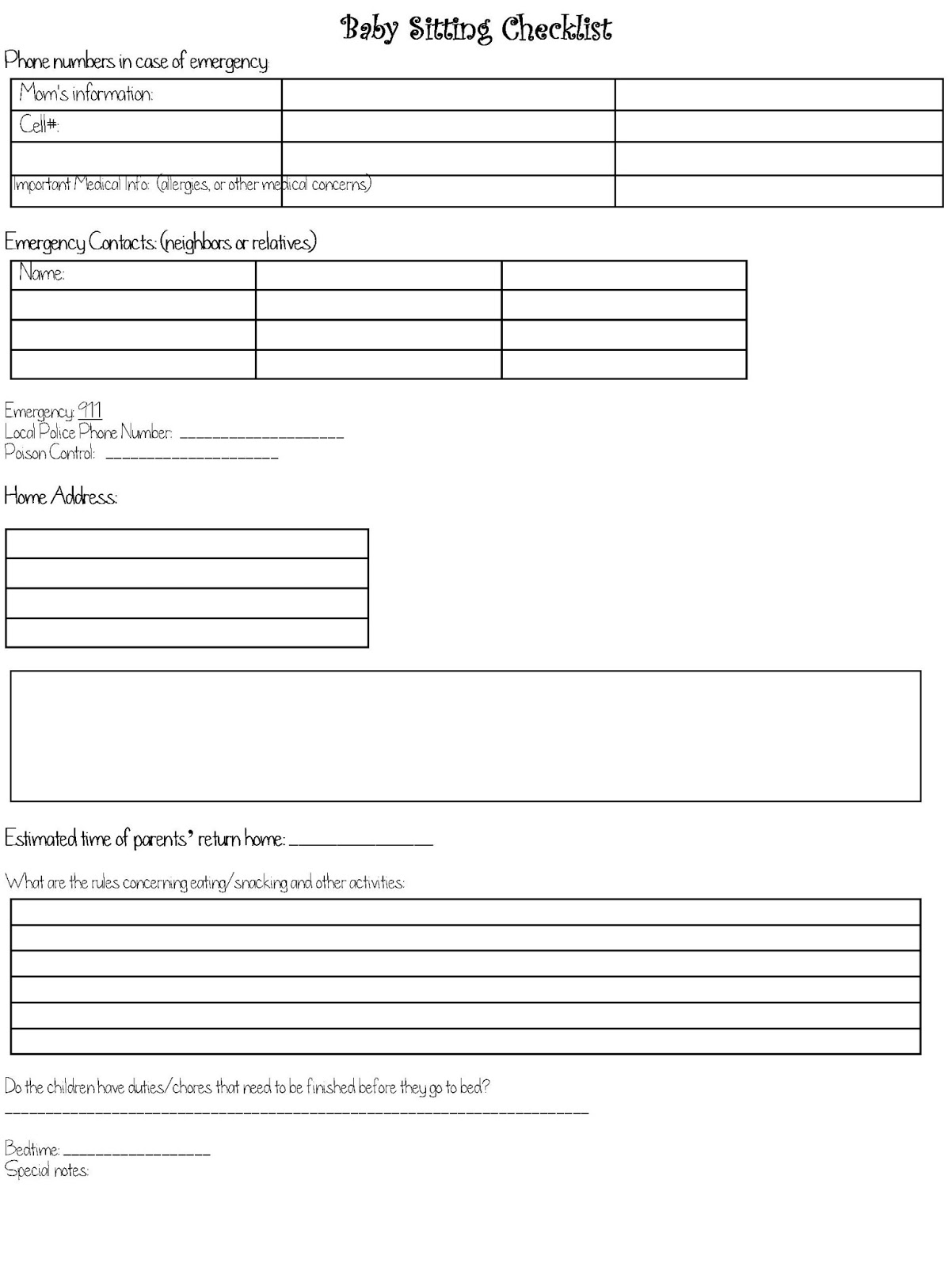
          • Before the parents leave, find out where they can be reached and ask for a list of phone numbers you can call in case of an emergency.  
          • Be aware of any physical limitations the children may have and what to do if they should need special care.  Know some practical first aid.  The best thing to do is to prevent any accident by watching the children carefully.
          • Good Babysitters should have a clear understanding of emergency contacts, rules, allergies, and bedtimes and more.
          • We also contacted a local EMS First Responder in our area to come to teach the girls a few basics of how to be prepared for an emergency and what to do till the ambulance arrives.


          What Can I Do with the Children?

          To a child everything is new and exciting.  To them life isn’t dull, learning is still fun, spontaneous, and exciting.  Children have boundless energy to throw into everything they do.  They play with fascination, quarrel with determination, and pursue any accepted project with deep intent.
          Because of their energy, it is sometime hard for them to concentrate for a great deal of time on any one subject.  Success in tending children includes variety, involvement, and a keen eye on the children’s particular interests.
          Try a few of these activities– read them ahead of time, so that what ever activities you choose to do – you can have all the item necessary to play the games or do the crafts.

          Keep an eye out for more fun things to do.  
          Get a medium sized bag to make a take-along-happy kit.  Use this to collect things like crayons, coloring books, puzzles, blocks, balls, jump ropes, construction paper, blunt-tip scissors, colored pencils, Silly-Putty/play dough, scratch paper, story books, glue sticks, froot-loops/rainbow/cheerios cereals, string—anything that would be fun for children, easy to carry, and safe to play with.
          If it’s a special time of year, take something to make or a bring a story book that tells about the time of year (Easter story, red white and blue construction paper to make flags, paper bags to make Halloween characters, etc.) remember to gauge your planned activities to the age of the children.  (For example, if you tend a four-year-old and a six-year-old on Valentines Day, take some colored paper and crayons so the children can make special Valentines for their parents, and let the children put the Valentines they make on the parents’ dresser or bed so they will see them when they come home.  Or if it is Easter time, collect stories to tell the children while they decorate egg cartons to put colored Easter eggs into.)
          You may find it fun to collect an idea file of things to do with children.  The Friend is a great magazine for ideas; take one with you if it isn’t already in the home.
          Another fun activity is to take games that the family may not have , but be careful about any “prizes” that you bring- remember parents might have guidelines about candy, toys, stickers and stamps.
          ProblemsWhat Do I Do Now?

          Sometimes baby sitters find that the children just won’t behave.  Your best bet is to find out why the children are naughty and lovingly treat the cause—never strike out at the symptoms.  Never lose your temper!  Often children get out of hand simply because they’re bored.  Keep in mind that the area of discipline is a very sensitive area, and the parents’ wishes should always be respected concerning their children.  Keep the children busy, happy, and safe, and you shouldn’t have difficult discipline problems to deal with.

          Things I Must Be Sure to Do
          Leave with your parents the address and phone number of where you will be tending, and tell them the approximate hour of your return.
          Make sure you have a safe and prompt way to return to your home before you ever leave.
          Dress properly and within the standards of the Church.  A modest pants outfit would be appropriate, especially when you play with the children in the yard or on the floor.
          The Very Best Part

          • The children always come first—you should tend them… focus on the children and having a safe and good time with them and not be focused of the time when the parents return.  
          • Be happy!  Children notice and will be happy too.  Be excited and enthusiastic—it’s contagious.  Remember there is never a time when you are in the house with children that you are not communicating with them in some way; everything you do is teaching the children.
          • Have fun with the children.  Play with them.  Let them help choose what to do.  Get to know them and enjoy them as people.  Involve them, listen to them, and learn from them— you’ll have a ball!
          I know that there are so many ideas that can help mature children become great babysitters- and I thought that it would be fun to share a few other sites that were great some of these sparked my imagination and helped build upon my ideas:

          We All Have Different Talents and Abilities

          Singing and Sharing
          Developing Talents

          I am Serving in my Ward as the Activity Day Leader, but this as well as other post I have can certainly be used for FHE, YW, YM, and just plain for fun.  I just hope that this will help someone else to magnify your callings too.

          I found a lesson in Gospel Principles Manual that was going to be perfect for us to help teach the idea about how developing our talents will serve our Heavenly Father.
          We began our activity by teaching the principle of “Developing Talents” by discussing the following taken from the Gospel Principles Manual:


          We all have special gifts, talents, and abilities given to us by our Heavenly Father. When we were born, we brought these gifts, talents, and abilities with us.

          The prophet Moses was a great leader, but he needed Aaron, his brother, to help as a spokesman (Exodus 4:14–16). Some of us are leaders like Moses or good speakers like Aaron. Some of us can sing well or play an instrument. Others of us may be good in sports or able to work well with our hands. Other talents we might have are understanding others, patience, cheerfulness, or the ability to teach others.

          We have a responsibility to develop the talents we have been given. Sometimes we think we do not have many talents or that other people have been blessed with more abilities than we possess. Sometimes we do not use our talents because we are afraid that we might fail or be criticized by others. We should not hide our talents. We should use them. Then others can see our good works and glorify our Heavenly Father (see Matthew 5:16).  


          We also Talked about how we should appreciate other peoples talents, and how we can develop our own talents by learning from others.

          Here was a cute Matt and Mandy Developing Talents Episode we shared in class.

          When we use our talents we are promised blessings- we will have an increase in our talents, and be blessed.

          I found this fun video on you tube and showed it to my group… Its about two missionaries that share their talents and the gospel.  It teaches that all our talents that we have or are developing, that we must use them to build up the kingdom of God.  To share our talents, to use our gifts to share the gospel and to bring people unto Christ.


          We called the Primary Chorister to ask her if our Activities Day group could help her plan and teach a song to the Primary during singing time.  She was so willing to participate.

          We chose to learn the ASL to Families can be Together Forever.


          Families can be Together Forever
          (I posted it the WMP and the MP4  …but it is also available for you to download from the above link- look to the right side and  you will find the link to download the ASL version- 
          I really like this version best.) 


          For some reason I could not view either on my iPad… so if you are still needing another version (American Sign language)- you should chose which works the best for your tablet, computer, group or family.  

          Now we plan to teach it to our Senior and Junior Primary group.  It will be a lot of work but the girls seem to like a fun challenge. We will do this till they have their Primary Program later this year.


          During our after school activity class time (if that’s what you want to call it) we will work on learning the sign language, make a little chart to help us remember what signs come when and then practice and practice. 

          I hope you have fun with this- 

          Valentine’s Day Scripture Chase

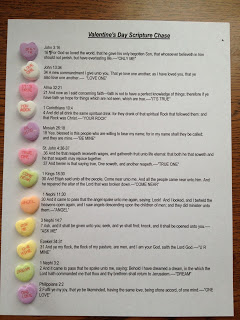
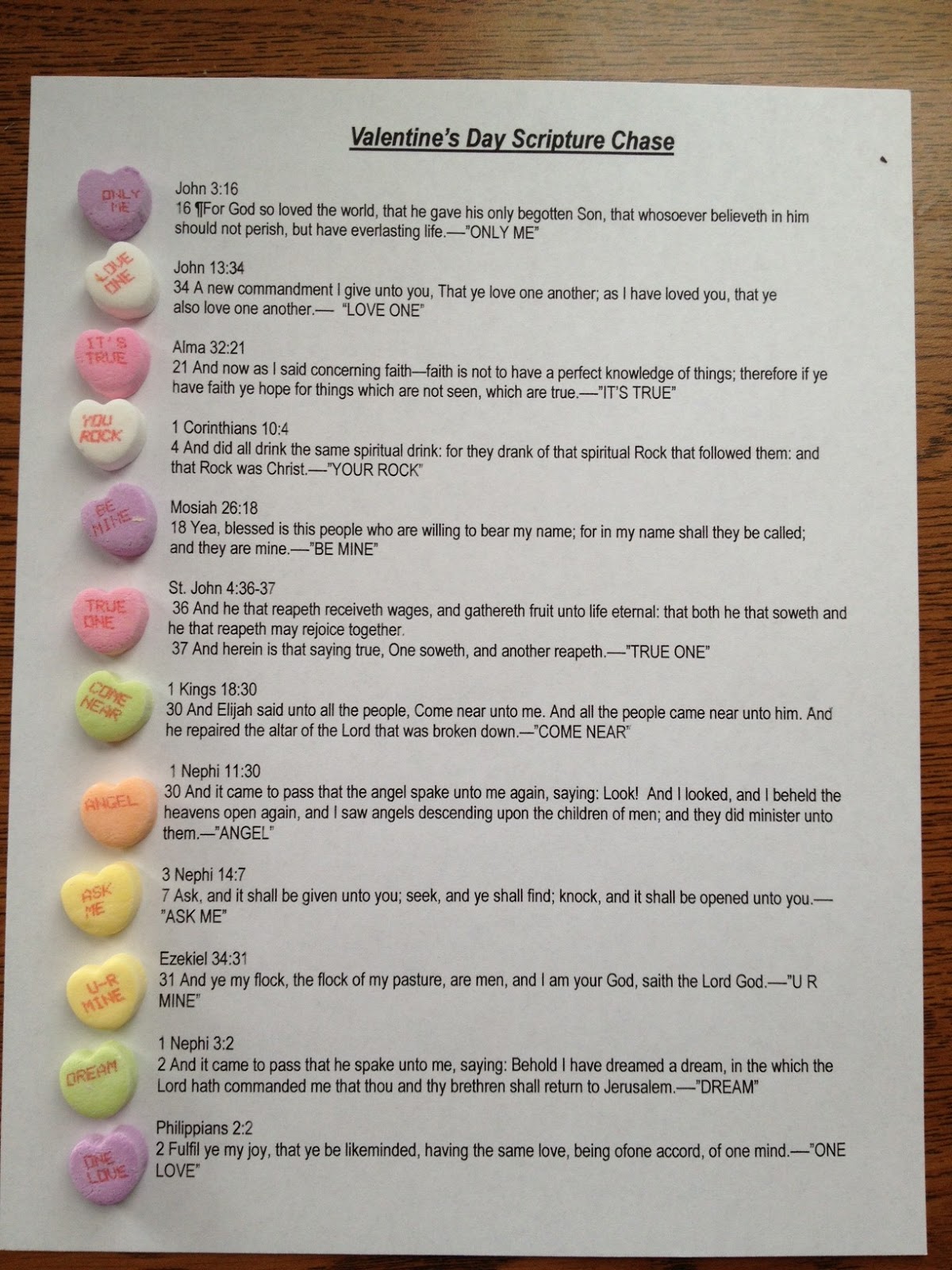
          So we wanted to come up with a fun way to do a scripture chase.  We found scriptures that fit with a Valentines theme… So we thought conversational hearts was super cute– the girls worked together to match up the hearts to the scriptures and find the answers.

          We divided up the girls into 2 groups to race with each other   They received the scripture reference  then they had to read it out loud, run to the candy bowl, pick out the conversational heart that it best matched with, run back to the group and read the next scripture.

          The first team to complete this game won a sticker- I am sure we could have found something better- but stickers are fun!

          Afterwards we went into the kitchen to decorate cupcakes with hearts and candy sprinkles.

          These girls are super fun!!

          Here is the list of Scriptures we used- but you may have to find the scriptures that best match your hearts:
          John 3:16

          16 For God so loved the world, that he gave his only begotten Son, that whosoever believeth in him should not perish, but have everlasting life.—
          ”ONLY ME”

          34 A new commandment I give unto you, That ye love one another; as I have loved you, that ye also love one another.—
           “LOVE ONE”

          21 And now as I said concerning faith—faith is not to have a perfect knowledge of things; therefore if ye have faith ye hope for things which are not seen, which are true.—
          ”IT’S TRUE”

          4 And did all drink the same spiritual drink: for they drank of that spiritual Rock that followed them: and that Rock was Christ.—
          ”YOU ROCK”

          18 Yea, blessed is this people who are willing to bear my name; for in my name shall they be called; and they are mine.—-”BE MINE”

           36 And he that reapeth receiveth wages, and gathereth fruit unto life eternal: that both he that soweth and he that reapeth may rejoice together.

           37 And herein is that saying true, One soweth, and another reapeth.—
          ”TRUE ONE”

          30 And Elijah said unto all the people, Come near unto me. And all the people came near unto him. And he repaired the altar of the Lord that was broken down.—
          ”COME NEAR”

          30 And it came to pass that the angel spake unto me again, saying: Look!  And I looked, and I beheld the heavens open again, and I saw angels descending upon the children of men; and they did minister unto them.—
          ”ANGEL”

          7 Ask, and it shall be given unto you; seek, and ye shall find; knock, and it shall be opened unto you.—
          ”ASK ME”

          31 And ye my flock, the flock of my pasture, are men, and I am your God, saith the Lord God.—
          ”U R MINE”
          2 And it came to pass that he spake unto me, saying: Behold I have dreamed a dream, in the which the Lord hath commanded me that thou and thy brethren shall return to Jerusalem.—
          ”DREAM”

          2 Fulfil ye my joy, that ye be likeminded, having the same love, being ofone accord, of one mind.—
          “ONE LOVE”


          THIS WEBSITE WILL CEASE OPERATIONS ON DEC 31, 2018.
          We are moving to http://NoBoringLessons.com/ where you can find Come Follow Me Lesson ideas for the new 2019 curriculum Dismiss