Mormon Share > Helping shy students participate
Archive
Jennifer Smith
December 31, 2012
Pose a question, and then hand several students a piece of chalk with an invitation to write their answers up on the board. Other students can line up for a turn when they are ready to respond, or students may hand off the chalk to others in the class for responses. The best questions for this exercises are broad with short answers, like “What are some of the biggest myths…
Read more
Jennifer Smith
December 31, 2012
Eaton and Beecher sometimes give students five minutes to prepare a 60-second talk on a verse from the day’s reading. Students then present their talks. If student become long-winded, offer a prize for the student who comes the closest to 60-seconds without going over. Nothing helps students lean a principle so well as having to explain it on their feet. Adapted from Becoming a Great Gospel Teacher, Eaton and Beecher…
Read more
Jennifer Smith
December 31, 2012

Assign students a passage or set of several verses to read. Have students imagine they are the prophet who would like to tweet the main idea of this passage or set of verses to his followers. What might he write? What will tell followers the most important information in fewer than 140 characters? After a few moments, share the tweets. Encourage them to write the best tweets in the margin…
Read more
Jennifer Smith
December 31, 2012
Have kids read a set of scriptures or passage. Pick an Appetizer – verse(s) that tantalize your own spiritual taste buds Beverage – cross-reference that helps wash down the Main Dish Main Dish – verse(s) that give an overall understanding of the entire block or main principle Dessert – short phrase that is spiritual topping to it all This exercise could be done as individuals, as groups, or as a…
Read more
Jennifer Smith
December 31, 2012
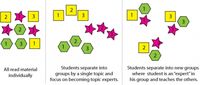
Jigsaw was first developed in the early 1970s by Elliot Aronson and his students at the University of Texas and the University of California. To teach using the Jigsaw method, “divide a topic up into, say, four sub-topics. For example childhood diseases could be divided into mumps, measles, whooping cough and German measles. Alternatively students can be given four different key questions or ‘spectacles’ that require students to analyze the…
Read more
Jennifer Smith
December 31, 2012
Our SI rep has been teaching us that when you separate into groups you should assign every member of the group a role. This helps each student participate in the group learning process. No matter the size of your group, you should assign a role to each student. Assignments may be given by the teacher, by a group/zone leader, or randomly. Here are some roles you might use in your…
Read more
Jennifer Smith
December 31, 2012
Give each student a pencil and piece of paper. Tell your students that they will be cartoonists and should draw a cartoon of the story you are about to read aloud. Stick figures are perfectly okay — this is not about drawing skill, but it’s about picking out the most important details they hear from the story. Let them know they will get a chance at the end of the…
Read more
Jennifer Smith
December 31, 2012
I used a unique set of questions to teach three parables: the parable of the of the ten virgins, the talents, and the sheep and goats. Before class I taped a set of three questions under each person’s chair. Each set of questions included one question from each of the three parables and was unique. I made the unique sets so that as we answered each question I wouldn’t get…
Read more
Jennifer Smith
December 31, 2012
Students pretend to be newscasters who tell a familiar gospel story. EXAMPLE: I told my students that we were going to pretend to be newscasters describing the events of Jesus’ triumphal entry into Jerusalem. Each zone received a section of Matthew 21 to give a news cast on. The parables were difficult, but the kids were able to cover them by doing those interview-style, like “You were present when Jesus…
Read more
Jennifer Smith
December 31, 2012
This is the easiest way to engage kids in scripture reading in my opinion. You’ll need something soft like a beanbag or small stuffed animal. A wadded up piece of paper could even be used in a pinch. You may need to lay out some ground rules like : – do not aim above the shoulders – no overhand tosses – no repeats After you make your reading assignment and…
Read more
Jennifer Smith
December 31, 2012
I use this technique when teaching something significant to missionary teaching. AFTER some instruction on a scripture passage or gospel principle, students are assigned into groups of three. Students read the same passage of scripture together as if this was a real missionary lesson. One person is the “nonmember,” and the other two are the missionaries. Missionaries make an effort to teach the principles found in the passage to the…
Read more
Jennifer Smith
December 31, 2012
Before class, invite a student to prepare a short talk or devotional about a topic or scripture passage. You should give the student clear instructions about what you’re looking for in the talk. For example, don’t just assign a student to read Moses 7:18 and give a talk on it. Explain to the student that you are teaching a lesson on unity. Moses 7:18 talks about unity and gives some…
Read more