Mormon Share > Eliciting thoughtful responses
Archive
Jennifer Smith
December 31, 2012
Ask students to find a scripture reference that answers a certain question. EXAMPLE: During a discussion on the word of wisdom in Daniel 1, I asked students to find a scripture reference to prove THAT God gives blessings to the obedient or WHY He does so, or HOW he blesses the obedient. They all found such great scripture references for this. I was shocked. Only a few came up with…
Read more
Jennifer Smith
December 31, 2012
This is a familiar but underused teaching technique. When you invite students to role play, “The students’ job is to shore up their friend, and they almost always bear testimony in the process — almost without realizing it.” (Becoming a Great Gospel Teacher, Eaton and Beecher, p 91) “We’ve had our students play everything from missionaries to parents of troubled youth to concerned friends. The more realistic the situation, the…
Read more
Jennifer Smith
December 31, 2012
Pose a question, and then hand several students a piece of chalk with an invitation to write their answers up on the board. Other students can line up for a turn when they are ready to respond, or students may hand off the chalk to others in the class for responses. The best questions for this exercises are broad with short answers, like “What are some of the biggest myths…
Read more
Jennifer Smith
December 31, 2012
Have students come up with a single word that best describes a verse(s) or principle/doctrine. (Adapted from Panning for Gold: Various Methods to Understand and Apply the Scriptures to Ourselves by Eric Bacon, Northwest Area Seminaries) Great for: Eliciting thoughtful responses, Helping students find meaning in the scriptures, Lesson opener Class size: Any class size Helps Students: SEARCH the scriptures or text Prep Time: Student Age: Any age Equipment needed:
Jennifer Smith
December 31, 2012
Eaton and Beecher sometimes give students five minutes to prepare a 60-second talk on a verse from the day’s reading. Students then present their talks. If student become long-winded, offer a prize for the student who comes the closest to 60-seconds without going over. Nothing helps students lean a principle so well as having to explain it on their feet. Adapted from Becoming a Great Gospel Teacher, Eaton and Beecher…
Read more
Jennifer Smith
December 31, 2012

Assign students a passage or set of several verses to read. Have students imagine they are the prophet who would like to tweet the main idea of this passage or set of verses to his followers. What might he write? What will tell followers the most important information in fewer than 140 characters? After a few moments, share the tweets. Encourage them to write the best tweets in the margin…
Read more
Jennifer Smith
December 31, 2012
As Nephi taught, we should “liken all scriptures unto us, that it might be for our profit and learning” (1 Nephi 19:23). Where could you or a student place your name or situation into the scriptures and make an appropriate application? Could you substitute your name for someone else’s or personalize the situation to make the scripture speak directly to you? Look For: Look for ways to put your name…
Read more
Jennifer Smith
December 31, 2012
Have kids read a set of scriptures or passage. Pick an Appetizer – verse(s) that tantalize your own spiritual taste buds Beverage – cross-reference that helps wash down the Main Dish Main Dish – verse(s) that give an overall understanding of the entire block or main principle Dessert – short phrase that is spiritual topping to it all This exercise could be done as individuals, as groups, or as a…
Read more
Jennifer Smith
December 31, 2012
At what point in the scripture block did the Spirit touch you and whisper to you that something you read was true? Maybe a particular part was something with which you have already had experience. Bear testimony of it during class, and invite students to do the same. Look For: Be aware of your feelings as you read. What verses touch you? Look for phrases that speak to you. Example:…
Read more
Jennifer Smith
December 31, 2012
Our SI rep has been teaching us that when you separate into groups you should assign every member of the group a role. This helps each student participate in the group learning process. No matter the size of your group, you should assign a role to each student. Assignments may be given by the teacher, by a group/zone leader, or randomly. Here are some roles you might use in your…
Read more
Jennifer Smith
December 31, 2012
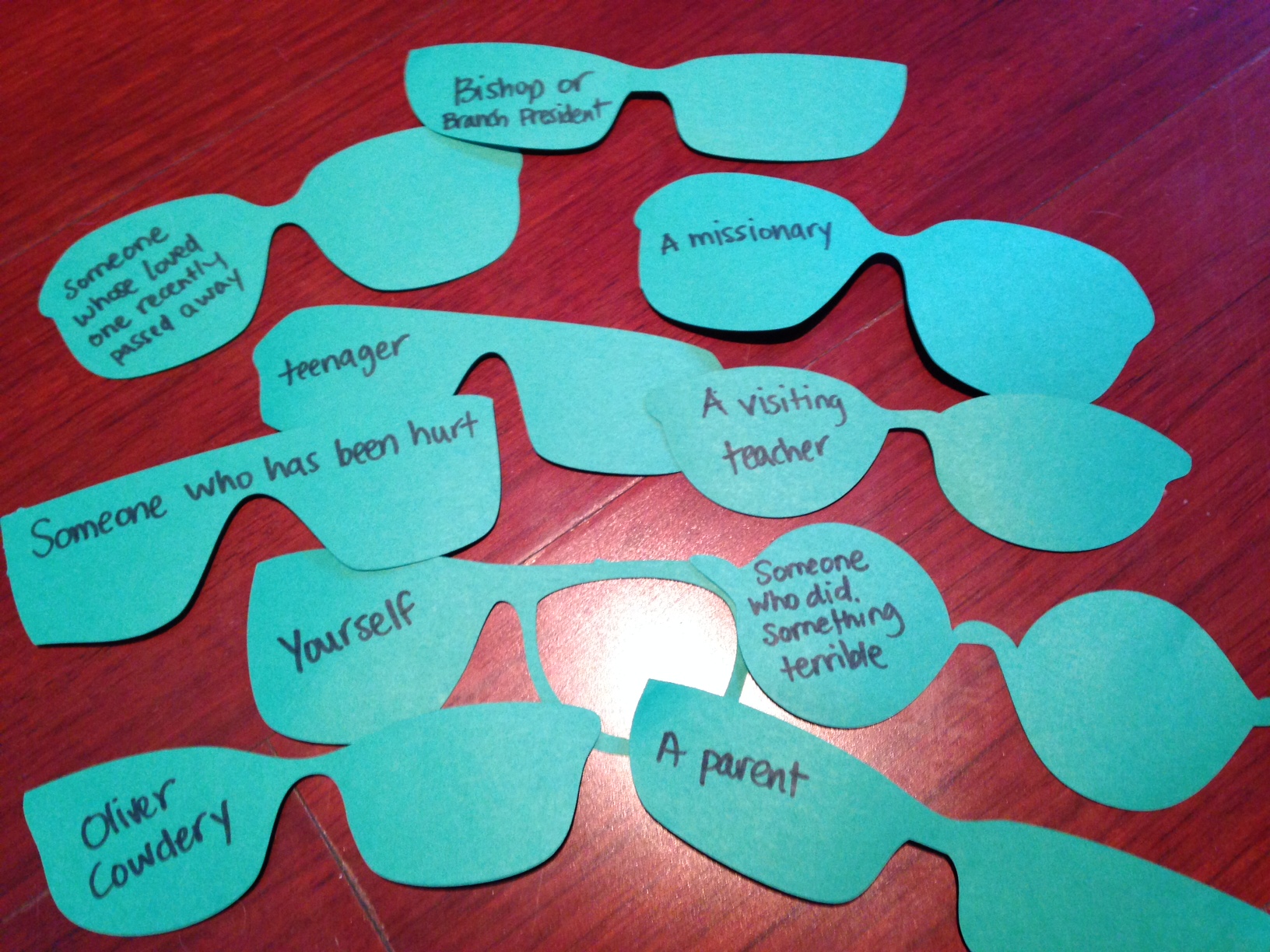
Read the same block with different eyes looking for different things, as if you were wearing a new pair of glasses with different lenses. A parent, a bishop, a missionary, a teenager, someone tired and depressed, someone newly married, someone needing repentance, someone who doesn’t get along with their parents, etc. For example, ask the students how this scripture verse might affect a person who has recently experienced a great…
Read more
Jennifer Smith
December 31, 2012
Give the kids a sum of fake money. Students will use the fake money to “buy” a scripture. The teacher auctions off different significant verses in a block of scriptures that students can search for principles and applications. You might even attach different candy to different verses — the “better” the verse (or, the more things to describe in the verse) the better/more candy there is so it is “worth”…
Read more