Mormon Share > Teaching Techniques
Teaching Techniques
Jennifer Smith
December 31, 2012
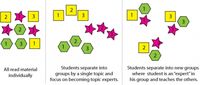
Jigsaw was first developed in the early 1970s by Elliot Aronson and his students at the University of Texas and the University of California. To teach using the Jigsaw method, “divide a topic up into, say, four sub-topics. For example childhood diseases could be divided into mumps, measles, whooping cough and German measles. Alternatively students can be given four different key questions or ‘spectacles’ that require students to analyze the…
Read more
Jennifer Smith
December 31, 2012
I learned this technique from Deann, who learned it from Linda D. When you have a large class of youth, you will need a seating chart to help behavior issues. It’s not mean — it’s positioning everyone so they can participate constructively. Daniel Roma teaches Seminary teachers that f you have more than five students, you need a seating chart. Deann seats her students boy/girl/boy/girl. I have never done that,…
Read more
Jennifer Smith
December 31, 2012
I used these questions on a worksheet to help students evaluate and understand personalities in the scriptures: :: Character Study :: Name: Scripture: Spouse/Children: Age: Hometown: Occupation: Describe this person using only three words. Circle the word you feel is this person’s core quality: ________________ , ________________ , ________________ Briefly describe the person’s attitude toward: Him/Herself _______________________________________________ Family ____________________________________________________ God ______________________________________________________ What problem(s) has this person experienced? Describe an event…
Read more
Jennifer Smith
December 31, 2012
Write the assigned verses or passages on a post it note. Mix up the order you will be covering the passages in, and stick an assignment under each seat in the classroom. When it comes time to read, have everyone look under their seat for their passage and read. I usually employ this method when we have several scriptures to read from different areas of the scriptures. Great for: Reading many…
Read more
Jennifer Smith
December 31, 2012
This is another form of student-directed randomized scripture reading. Students stand to read a verse and then call the name of someone else to stand and read the following verse. The kids are “popping” up to read. This is also a good technique when you’re doing Everybody Writes (each student writes a a brief response to something and then reports). Great for: Reading aloud, Reading a long passage, Helping shy students…
Read more
Jennifer Smith
December 31, 2012
For many teachers, there is an imaginary line about 5 feet in front of the chalkboard, near the table. Students do not cross that line, nor do teachers. One of the best Classroom management skills you can develop is breaking The Plane, or getting in the habit of moving about the classroom as you teach. There’s a great discussion of this in the book Teach Like a Champion by Doug…
Read more
Jennifer Smith
December 31, 2012
Have each student read a scripture on a gospel topic or a keyword written on a wordstrip and then place that wordstrip under the correct header. EXAMPLE: I used this method to teach the plan of salvation. I divided the board into three sections: premortal, mortal, and postmortal. I also stuck Post-it notes with words like fall, creation, resurrection, birth, war in heaven, outer darkness, death, celestial glory, paradise, spirit…
Read more
Jennifer Smith
December 31, 2012
You know how this works: each student’s name is written on a piece of paper. You draw a name out and that’s the person who reads or prays next. EXAMPLE: I use a bucket with craft sticks that have each student’s name written on it. One end of the stick is red and the other is green. Students with red facing up, have been chosen. It’s an easy way to…
Read more
Jennifer Smith
December 31, 2012
Each student has a Styrofoam plate, a wet wipe, and a regular (not permanent) marker. Ask students questions that can be answered in a few short phrases. They write their answers and flip over their plates. After a few moments, ask everybody to display their plates. I have used this as a lesson review quiz and as a Lesson opener to help me determine what students already understand about a…
Read more
Jennifer Smith
December 31, 2012
Tell students you will give them sixty seconds to find out everything they can about a certain passage. If this is the first time your students have done an activity like this, you may want to give them a chance to tell you some techniques they might want to use: reading the chapter header, checking the footnotes, skimming, watching for the paragraph markers, etc. Turn them loose. When the timer…
Read more
Jennifer Smith
December 31, 2012
WordStorm is kind of like brainstorming in that you take a topic word and write down the class’ thoughts on the board. Easy Lesson opener. EXAMPLE: I wrote the word “friend” on the board and asked my students to say words that describe a perfect friend. I noted their words on the board. When they slowed, I pointed out that Jesus Christ called some people his friends in the scriptures….
Read more
Jennifer Smith
December 31, 2012
Teachers can randomly assign students to read randomly by calling them by name. The key is the order of the direction and the assignment. Here’s how: “Turn in your Bible to Isaiah chapter 1. [pause] Everyone look at your scriptures. We’ll be reading verses 1-15 aloud one at a time and discussing each individually. Verse one …[pause]… John?” The important thing is to direct everyone to the verse, pause, and…
Read more